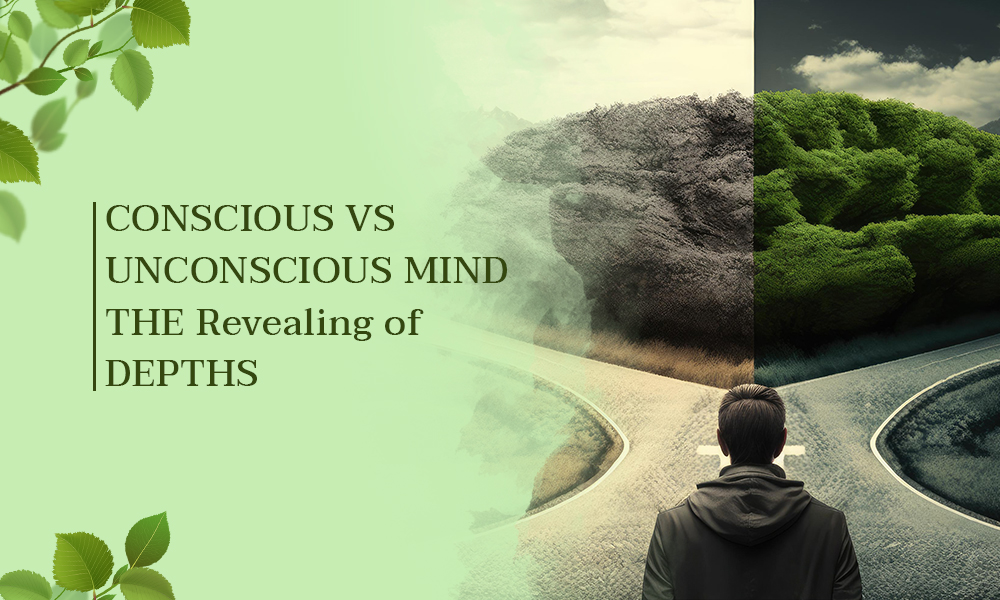
The conscious and unconscious mind are mysterious domains that influence our ideas, behaviors, and perceptions in the complex web of human cognition. They interact with one another constantly, like the two sides of a coin, and often influence one another in ways that are not readily apparent.
The key to understanding the complexity of human behavior and experience lies in both the conscious mind—that which we are aware of while we are awake—and the unconscious mind—the secret repository of our innermost wants, fears, and memories.
Understanding Consciousness:
- Think of the conscious mind as the sun, shining its bright rays over the expanse of our ideas. It is the area of conscious cognition, where reason and logic predominate. Here, we ponder, consider the options, and choose.
- It is the territory of self-awareness, where we reflect on our existence and evaluate the environment we live in.
- Every action, including every choice and problem-solving decision, is organized by the conscious mind. The domain of the unconscious mind, a huge ocean of ideas and emotions that stay concealed from our immediate consciousness, sits just below this shimmering surface.
- Dreams develop here, memories solidify, and the ingrained patterns of our life become apparent. The unconscious acts as a mysterious force that often directs our activities without our knowledge.
Learn the Depths of Unconscious Mind
- Despite being hidden, the unconscious mind has a significant impact on how our lives turn out.
- It serves as a reservoir for forgotten memories that often surface unexpectedly, much like lost riches that the waves of time have swept ashore.
- Once suppressed, deep-seated emotions may erupt like molten lava from the earth's core, influencing our actions and relationships in ways we might not completely understand.
- An unconscious mind is a skilled puppeteer who is secretly manipulating the events. All of our preferences, dislikes, and irrational fears have their origins in this obscure region.
Have you ever wondered why some smells bring back strong memories or why you feel uneasy around certain people? The winding paths of the unconscious contain the solution.

Collaboration of Both :
Despite their differences, the conscious and unconscious brains collaborate to shape the human experience in a complex dance. We may successfully negotiate the difficulties of everyday life thanks to the torchlight that the conscious mind shines on the immediate route.
It is where we make thoughtful decisions, converse with one another, and use linear reasoning to solve issues. When the conscious mind runs against a brick wall, the unconscious mind steps in to provide insights and original solutions.
The unconscious mind may come to the fore during times of relaxation, daydreaming, or even sleep, producing the "aha" moments that seem to appear out of nowhere.
Explore the Mystery :
Learning how the conscious and unconscious brains interact is like cracking a code that controls how people behave.
To uncover the underlying motives and conflicts that influence our ideas and actions, psychoanalysts and psychologists have gone into the depths of the unconscious mind.
These approaches include dream interpretation and free association.
We start to understand that we are not only the commanders of our conscious ideas but also the explorers of our unconscious depths, as we start to peel back the layers of our brains.
The quest for self-discovery is a never-ending trip into the undiscovered mental landscapes where the conscious and unconscious brains converge to create the complex human experience mosaic.
Conclusion
The conscious and unconscious brains work together to create a great symphony of knowledge in this delicate balance rather than as rivals. Together, they arrange the complex dance of our lives and create the melodies of our thoughts, feelings, and cadences.