Introduction
One thing that people often misunderstand about autism is that they immediately associate it with limitations. Many individuals still assume that autistic people cannot succeed socially, professionally, or creatively in the same way others can. However, reality tells a very different story.
Autism Spectrum Disorder (ASD) affects how a person experiences communication, emotions, sensory input, social interaction, and daily routines. Since autism exists on a spectrum, every autistic individual experiences life differently. Some may need more support in certain areas, while others may live independently and build highly successful careers.
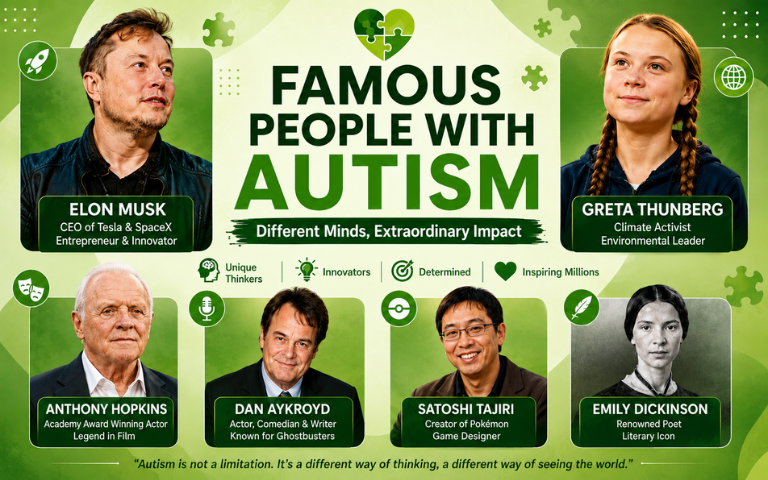
These individuals have made major contributions to science, business, entertainment, sports, and advocacy while inspiring millions of people around the world.
1. Emily Dickinson
One historical figure who is widely believed by many researchers and psychologists to have shown traits associated with autism is Emily Dickinson. Although autism was not medically understood during her lifetime, many aspects of Dickinson’s behavior and lifestyle have led experts to speculate that she may have been on the autism spectrum.
Emily Dickinson was known for living a highly isolated life and avoiding social interaction for long periods of time. She preferred spending time alone, focused intensely on writing, and communicated more comfortably through letters and poetry rather than face-to-face conversations.
Despite living privately, Dickinson became one of the most influential poets in history. Her writing style was deeply unique, emotional, and unconventional, which set her apart from many writers of her time.
Her story highlights an important truth about autism: people who think differently often contribute extraordinary creativity and originality to the world. Traits that society may misunderstand or label as “unusual” can sometimes become the very qualities that lead to brilliance and innovation.
2. Elon Musk
Another well-known public figure associated with autism is Elon Musk. During a television appearance, he openly revealed that he has Asperger’s Syndrome, which falls under the autism spectrum.
Elon Musk is known worldwide for his work in technology and innovation through companies like Tesla and SpaceX. His ability to think differently, focus intensely on goals, and approach problems unconventionally has played a major role in his success.
His openness about being on the spectrum also helped reduce stigma surrounding autism, especially for adults who may feel insecure about being different socially or emotionally.
While autism can create social and communication difficulties for some individuals, many autistic people also possess exceptional concentration and deep interest in specific subjects. Elon Musk’s story highlights how neurological differences do not prevent innovation or achievement.
3. Anthony Hopkins
Award-winning actor Anthony Hopkins has also spoken publicly about being on the autism spectrum. Known for his incredible performances in films and television, Hopkins shared that he was diagnosed later in life.
For many adults, autism is not identified until years later because symptoms can sometimes appear differently than expected. Some individuals grow up simply feeling “different” without fully understanding why they struggle socially or emotionally.
Anthony Hopkins mentioned that autism affected certain aspects of his interactions and relationships, but he also believes it contributed to his ability to focus intensely on acting and character development.
His story reminds people that autism does not always look the same in every person. Some autistic individuals may appear highly functional outwardly while privately facing emotional or social difficulties that others cannot see.
4. Greta Thunberg
Greta Thunberg is another globally recognized figure on the autism spectrum. The young climate activist has openly described her autism as her “superpower” because it allows her to remain deeply focused and passionate about important issues.
Greta became internationally known for her environmental activism and speeches about climate change. Despite facing criticism, bullying, and intense public attention, she continued advocating strongly for environmental responsibility.
Her openness about autism helped challenge harmful stereotypes, especially regarding young autistic individuals. Many people mistakenly assume autistic individuals are incapable of leadership or public influence, yet Greta became one of the most recognizable activists in the world.
Her story demonstrates that autistic people can become powerful voices for change when their strengths and passions are supported instead of dismissed.
5. Dan Aykroyd
Actor and comedian Dan Aykroyd has also discussed being diagnosed with Asperger’s Syndrome. Best known for his work in comedy and film, Aykroyd mentioned that some autistic traits influenced both his creativity and personal interests.
Many autistic individuals develop intense interests or hobbies that they become deeply knowledgeable about. While society sometimes views these interests as unusual, they can actually become major strengths in professional and creative fields.
Dan Aykroyd’s career shows that autistic individuals can thrive in entertainment, humor, and storytelling despite common misconceptions that autism always limits emotional expression or creativity.
6. Satoshi Tajiri
Many people may not know that Satoshi Tajiri, the creator of Pokémon, is believed to be on the autism spectrum.
As a child, Tajiri was deeply fascinated with collecting insects and exploring nature. His strong focus on collecting and categorizing eventually inspired the idea behind Pokémon.
This highlights something important about autism: passionate interests are not meaningless obsessions. Sometimes they become the foundation for innovation, creativity, and groundbreaking ideas.
Millions of people worldwide grew up with Pokémon, yet few realize that the inspiration behind it came from a mind that experienced the world differently.
Autism and Unique Strengths
Autism can come with genuine challenges, mostly starting from early childhood, including sensory sensitivities, communication struggles, and difficulty with change, anxiety, or social exhaustion. These struggles should never be ignored or minimized.
However, it is equally important to recognize the strengths many autistic individuals possess. Some common strengths associated with autism include:
- Strong attention to detail
- Creativity and imagination
- Deep focus and concentration
- Honesty and authenticity
- Excellent memory
- Unique problem-solving skills
- Passion for specific interests
Unfortunately, society often focuses only on what autistic individuals struggle with instead of appreciating what they contribute.
The Importance of Acceptance
One of the greatest difficulties autistic individuals face is not always autism itself, but the lack of understanding from society. Judgment, bullying, exclusion, and unrealistic expectations can seriously affect the mental health and confidence of autistic individuals.
Acceptance does not mean forcing autistic people to behave like everyone else. It means creating environments where they feel respected, supported, and understood.
Families, schools, workplaces, and communities all play an important role in supporting autistic individuals by:
- Encouraging their strengths
- Understanding sensory needs
- Being patient with communication differences
- Reducing stigma around autism
- Creating inclusive environments
The more society learns about autism, the easier it becomes to replace stereotypes with understanding and compassion.
Final Thoughts
Famous people with Autism Spectrum Disorder continue to inspire millions around the world by proving that success is not limited by neurological differences. Their achievements remind us that autism is not something that makes a person “less than.” It is simply a different way of experiencing and understanding the world.
Every autistic individual has their own strengths, challenges, talents, and personality. Some may become scientists, artists, entrepreneurs, athletes, teachers, or advocates. Others may simply want to live peaceful and fulfilling lives surrounded by acceptance and support.
What truly matters is creating a world where autistic individuals are valued for who they are instead of constantly being judged for being different. At Transformation International Society, we believe that every individual deserves understanding, support, and opportunities to thrive regardless of their neurological differences.