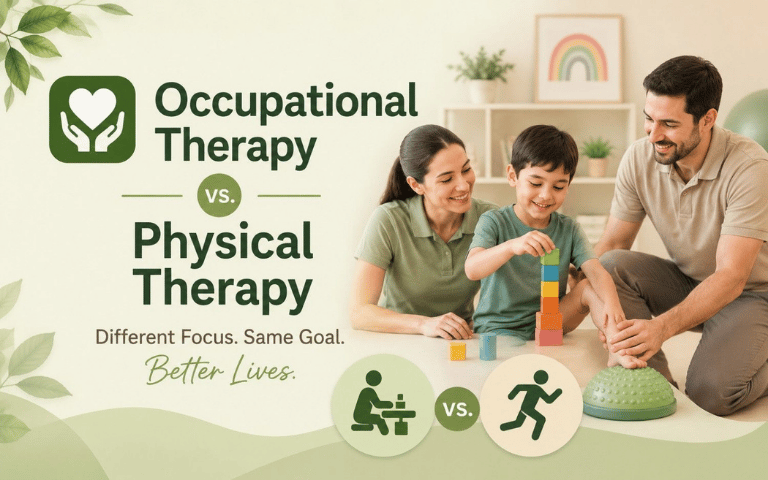
Occupational therapy and physical therapy are often confused with each other, and honestly, it makes sense. Both help people improve their quality of life, both involve movement and rehabilitation, and both are commonly recommended after injuries, illnesses, or developmental challenges.
But while they may seem similar at first, their goals are actually quite different.
Let’s break it down in a simple way.
What Is Occupational Therapy?
Occupational therapy, often called OT, focuses on helping people perform everyday activities more independently.
The word “occupation” here doesn’t just mean jobs or careers. It refers to daily activities that “occupy” a person’s life, such as:
- Eating
- Writing
- Getting dressed
- Bathing
- Playing
- Using school tools
- Social interaction
An occupational therapist works on improving the skills needed to complete these tasks comfortably and confidently.
For children, OT may help with:
- Fine motor skills
- Hand-eye coordination
- Sensory processing
- Attention and focus
- Daily routines
For adults, it may involve relearning life skills after an injury, surgery, stroke, or medical condition.
The main goal of occupational therapy is simple: helping people function better in their daily lives.
What Is Physical Therapy?
Physical therapy, also known as PT, focuses more on movement, strength, and physical function.
A physical therapist helps people improve how their bodies move and work. This usually involves:
- Strengthening muscles
- Improving balance
- Reducing pain
- Increasing mobility
- Recovering after injuries or surgeries
For example, someone recovering from a broken leg may need physical therapy to walk properly again. A child with difficulty balancing or walking may also benefit from PT.
Physical therapy often includes:
- Stretching exercises
- Balance training
- Muscle strengthening
- Posture correction
- Mobility exercises
The overall goal is to improve physical movement and reduce limitations in the body.
The Main Difference
The easiest way to understand the difference is this:
- Occupational therapy helps people perform daily activities
- Physical therapy helps people improve physical movement
In other words:
- OT focuses on what a person needs to do
- PT focuses on how the body moves to do it
For example, if a child struggles to hold a pencil, button clothes, or tolerate certain textures, occupational therapy may help. If a child has weak muscles, poor balance, or difficulty walking, physical therapy may be recommended.
Sometimes, a person may even need both therapies together.
Do They Work Together?
Yes, very often. Occupational therapists and physical therapists frequently work as part of the same support team, especially for children with developmental delays, autism, injuries, or neurological conditions.
For example, a physical therapist may help a child improve posture and muscle strength. An occupational therapist may then help the child use those improved skills for writing, eating, or classroom activities.
Both therapies complement each other and can play an important role in a person’s progress.
Which One Is Better?
Neither is “better” than the other. It completely depends on the individual’s needs.
Someone struggling with movement and pain may benefit more from physical therapy, while someone facing challenges with daily tasks or sensory regulation may need occupational therapy.
In many cases, professionals assess the individual first and then recommend the right type of support.
Can Someone Need Both?
Yes, absolutely. Many people benefit from both therapies together.
For example, a stroke patient may need physical therapy to walk again and occupational therapy to relearn daily tasks like eating or dressing.
A child with developmental challenges may work on posture and balance in physical therapy while improving sensory and fine motor skills in occupational therapy.
The two therapies often complement each other.
Final Thoughts
Occupational therapy and physical therapy may sound similar, but they focus on different parts of a person’s wellbeing. One works on improving everyday functioning, while the other focuses on strengthening physical movement and mobility.
Both therapies can make a meaningful difference in helping children and adults become more independent, confident, and comfortable in their daily lives. Awareness and early support can make a huge impact on a person’s growth and well-being. Transformation International Society continues to support individuals and families through guidance, therapy, and community care.