- Jofa Tower 5th floor, SB-23, Block 13 C, Main University Rd, Gulshan-e-Iqbal, Karachi.
- +92 322 3746726
- tis@transformation.com.pk

Types of Autism Spectrum Disorder Explained

Most Common Neurological Disorders Explained
June 2, 2026
Causes and Symptoms of ASD Explained
June 6, 2026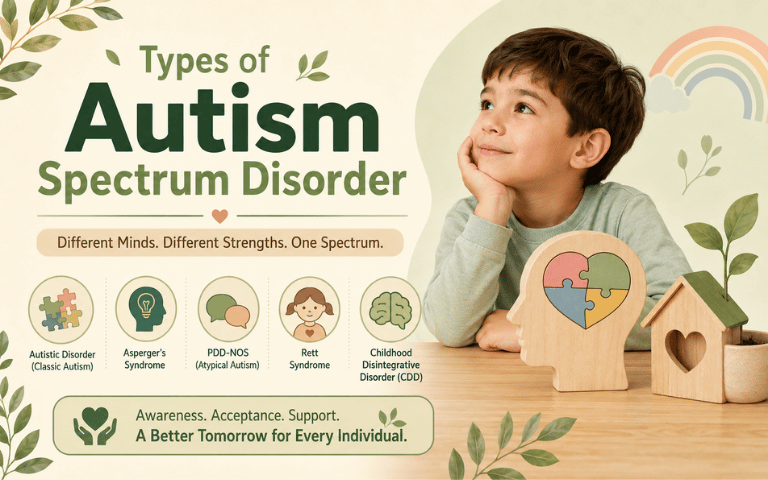
Autism spectrum disorder is a neurodevelopmental condition that affects communication, behavior, social interaction, and sensory processing. Autism is called a “spectrum” because it affects individuals in different ways and with varying levels of support needs.
In the past, autism was divided into several separate categories or subtypes. Although modern medical diagnosis now groups these conditions under the broader term Autism Spectrum Disorder (ASD), many people still refer to the older classifications to better understand different presentations of autism.
Here are the most commonly recognized types associated with Autism Spectrum Disorder.
1. Autistic Disorder (Classic Autism)
Autistic Disorder, often called classic autism, is considered one of the more recognizable forms of autism.
Individuals with classic autism may experience:
- Significant communication difficulties
- Delayed speech or nonverbal communication
- Challenges with social interaction
- Repetitive behaviors or routines
- Sensory sensitivities
Some individuals may also have intellectual disabilities, while others may have average or above-average intelligence.
Support needs can vary depending on the severity of symptoms and the individual’s strengths and challenges.
2. Asperger’s Syndrome
Asperger syndrome was previously considered a separate type of autism. Individuals with Asperger’s syndrome usually do not have significant language delays or intellectual disabilities.
Common characteristics may include:
- Difficulty understanding social cues
- Intense interest in specific topics
- Preference for routines
- Challenges with social communication
- Sensory sensitivities
Many individuals with Asperger’s syndrome have strong verbal skills and average or high intelligence. However, they may still struggle with social interaction and emotional regulation.
Today, Asperger’s syndrome is generally included under the broader diagnosis of Autism Spectrum Disorder.
3. Pervasive Developmental Disorder – Not Otherwise Specified (PDD-NOS)
PDD-NOS was sometimes referred to as “atypical autism.” It was diagnosed when a person showed some, but not all, characteristics of classic autism.
Individuals with PDD-NOS may experience:
- Mild to moderate social difficulties
- Communication challenges
- Repetitive behaviors
- Delayed developmental skills
Symptoms were often less severe or did not fully match other autism categories. Because presentations varied greatly, PDD-NOS covered a wide range of developmental differences.
This diagnosis is now generally classified under Autism Spectrum Disorder.
4. Rett Syndrome
Rett syndrome is a rare neurological and developmental disorder that mainly affects girls. Children with Rett syndrome may initially appear to develop normally before gradually losing certain motor and communication skills.
Common symptoms include:
- Loss of hand skills
- Repetitive hand movements
- Difficulty walking
- Speech and communication challenges
- Breathing irregularities
Although Rett syndrome was previously grouped with autism-related conditions because of similarities in behavior and communication difficulties, it is now recognized as a separate genetic neurological disorder.
5. Childhood Disintegrative Disorder (CDD)
Childhood disintegrative disorder is a rare condition in which a child develops typically during the early years of life and then experiences a significant loss of previously learned skills.
Children with CDD may lose:
- Language abilities
- Social skills
- Motor skills
- Toilet training abilities
- Communication skills
Symptoms usually appear after the age of two. Because of the sudden developmental regression, CDD is considered one of the more severe autism-related conditions.
Today, it is also included under the broader autism spectrum classification.
Understanding the Autism Spectrum Today
Modern diagnostic systems no longer separate autism into these individual categories. Instead, all of these conditions are generally included under the diagnosis of Autism Spectrum Disorder (ASD).
Healthcare professionals now focus more on:
- Severity of symptoms
- Communication abilities
- Sensory needs
- Level of support required
- Individual strengths and challenges
This approach recognizes that every autistic person is unique and may experience autism differently.
Final Thoughts
Autism Spectrum Disorder is not a single, identical experience for everyone. The different types and presentations of autism show how widely symptoms, strengths, communication styles, and support needs can vary from one individual to another.
Understanding these different forms of autism helps create greater awareness, acceptance, and support for autistic individuals and their families.
Organizations like Transformation International Society continue working to spread awareness about autism and provide support, therapy, and guidance for individuals with developmental and neurological conditions.