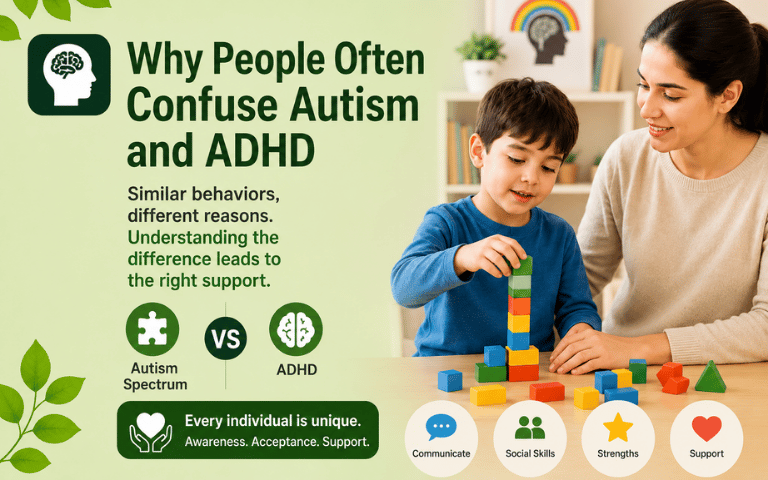
Why People Often Confuse Autism and ADHD
One thing that people commonly misunderstand is that Autism Spectrum Disorder (ASD) and Attention-Deficit/Hyperactivity Disorder (ADHD) are the same condition. Since both can affect behavior, communication, focus, emotions, and social interaction, many people struggle to tell the difference between them.
The truth is that autism and ADHD are completely separate neurodevelopmental conditions, although they can sometimes overlap. In fact, many individuals can have both autism and ADHD at the same time, which can make diagnosis more complicated.
Because some symptoms appear similar on the surface, people often confuse the two. For example, both autistic individuals and people with ADHD may struggle socially, become overwhelmed easily, or have difficulty focusing in certain situations. However, the reasons behind these behaviors are often very different.
Understanding these differences is important because proper support depends on recognizing the specific needs of each individual rather than assuming every person experiences these conditions in the same way.
What is Autism Spectrum Disorder?
Autism Spectrum Disorder (ASD) is a neurological and developmental condition that affects how a person communicates, interacts socially, processes sensory information, and experiences the world around them.
Autism exists on a spectrum, meaning every autistic individual is different. Some people may require significant support in daily life, while others may live independently and build successful careers.
Common characteristics of autism may include:
- Difficulty understanding social cues
- Sensory sensitivities
- Preference for routines and predictability
- Intense interests in specific topics
- Repetitive behaviors or movements
- Difficulty expressing emotions conventionally
- Challenges with change or transitions
Autistic individuals often experience the world very intensely. Bright lights, loud sounds, textures, crowded places, or sudden changes can become overwhelming for them.
One important thing to understand is that autism is not an illness that needs to be “fixed.” It is a different way of processing and experiencing the world.
What is ADHD?
Attention-Deficit/Hyperactivity Disorder (ADHD) is another neurodevelopmental condition, but it primarily affects attention regulation, impulse control, activity levels, and executive functioning.
People with ADHD often struggle with maintaining focus, organizing tasks, sitting still for long periods, or controlling impulsive behaviors. Their brains constantly seek stimulation, which can make routine tasks feel mentally exhausting.
Common signs of ADHD may include:
- Difficulty concentrating
- Forgetfulness
- Hyperactivity
- Restlessness
- Impulsive decision-making
- Trouble staying organized
- Frequently losing things
- Difficulty completing tasks
ADHD does not mean someone is lazy or unintelligent. In fact, many individuals with ADHD are highly creative, energetic, and capable. The challenge lies in regulating attention and managing daily responsibilities consistently.
While autism is often associated with routine and predictability, ADHD is more commonly associated with impulsivity and difficulty maintaining structure.
Social Differences
One of the biggest differences between autism and ADHD involves social interaction.
Autistic individuals may struggle with understanding social rules, facial expressions, body language, tone of voice, or unspoken expectations in conversations. Some autistic people may prefer limited social interaction because social situations can feel mentally exhausting or confusing.
For example, an autistic person may:
- Avoid eye contact
- Miss sarcasm or jokes
- Struggle with small talk
- Prefer direct communication
- Feel overwhelmed in group settings
Meanwhile, people with ADHD usually understand social cues but may struggle socially because of impulsivity or inattentiveness.
For example, someone with ADHD may:
- Interrupt conversations frequently
- Speak without thinking
- Lose focus during conversations
- Forget important details
- Appear impatient or restless
The difference is that autistic individuals often struggle with understanding social communication itself, while individuals with ADHD generally understand social interaction but may have difficulty regulating their behavior during it.
Routine vs Impulsivity
Another major difference between autism and ADHD is how individuals respond to routine and structure.
Many autistic individuals rely heavily on routines because predictability creates comfort and stability. Sudden changes in plans, schedules, or environments can feel deeply distressing.
Autistic individuals may:
- Prefer strict routines
- Eat the same foods repeatedly
- Become upset by unexpected changes
- Follow familiar patterns daily
On the other hand, people with ADHD often struggle to maintain routines consistently. They may want structure but find it difficult to follow through because of distractibility or impulsive behavior.
Individuals with ADHD may:
- Start tasks enthusiastically but not finish them
- Forget schedules or deadlines
- Become bored quickly
- Constantly seek new stimulation or excitement
In simple terms, autistic individuals often crave predictability, while individuals with ADHD may struggle to stay consistent with structure.
Sensory Issues
Sensory sensitivities are far more common and intense in autism, although some individuals with ADHD can also experience sensory challenges.
Autistic individuals may become overwhelmed by:
- Loud noises
- Bright lights
- Certain textures
- Strong smells
- Crowded spaces
These sensory experiences can sometimes lead to shutdowns, meltdowns, anxiety, or emotional exhaustion.
People with ADHD may also experience sensory sensitivity, but it often appears differently. They may seek stimulation rather than avoid it. For example, they may constantly move, fidget, or look for sensory input because their brains crave activity and engagement.
This is why some individuals with ADHD appear constantly restless, while autistic individuals may become overwhelmed and withdraw from overstimulating environments.
Focus and Attention
Many people assume autistic individuals cannot focus, but this is not entirely accurate. In fact, many autistic people can focus intensely on topics or activities they are deeply interested in.
This is often called “hyperfocus.” Autistic individuals may spend hours researching or engaging in subjects they are passionate about.
People with ADHD can also hyperfocus, but their attention regulation is usually more inconsistent. They may focus intensely on stimulating activities while struggling greatly with tasks they find repetitive or uninteresting.
For example:
- An autistic individual may focus deeply on one specific interest for years
- A person with ADHD may jump rapidly between interests depending on stimulation and excitement levels
Both conditions affect attention differently, even if the behaviors sometimes look similar from the outside.
Final Thoughts
Autism and ADHD are different neurodevelopmental conditions, even though they may share some overlapping traits. Autism mainly affects social communication, sensory processing, and behavioral patterns, while ADHD primarily affects attention regulation, impulsivity, and executive functioning.
The most important thing to remember is that neither autism nor ADHD makes a person “less capable.” Neurodivergent individuals simply experience and process the world differently.
Understanding these conditions with empathy rather than judgment helps create more supportive homes, schools, workplaces, and communities for everyone.
At Transformation International Society, we are committed to spreading awareness about neurodevelopmental conditions like autism and ADHD while supporting individuals and families through compassion, education, and advocacy. Every individual deserves understanding, acceptance, and the opportunity to thrive.